Great and Holy Week: The Week of the Bridegroom in the Byzantine Church and Some Contributions of the East to Catholic Theology on Marriage
In this article, Theo McManigal, who is a Byzantine Catholic, shares why the Byzantine Catholic Church calls Holy Week the “Week of the Bridegroom” and he also shares some insights from Una Caro which have helped him see how his Byzantine Catholicism relates closely to the work he does for this apostolate.
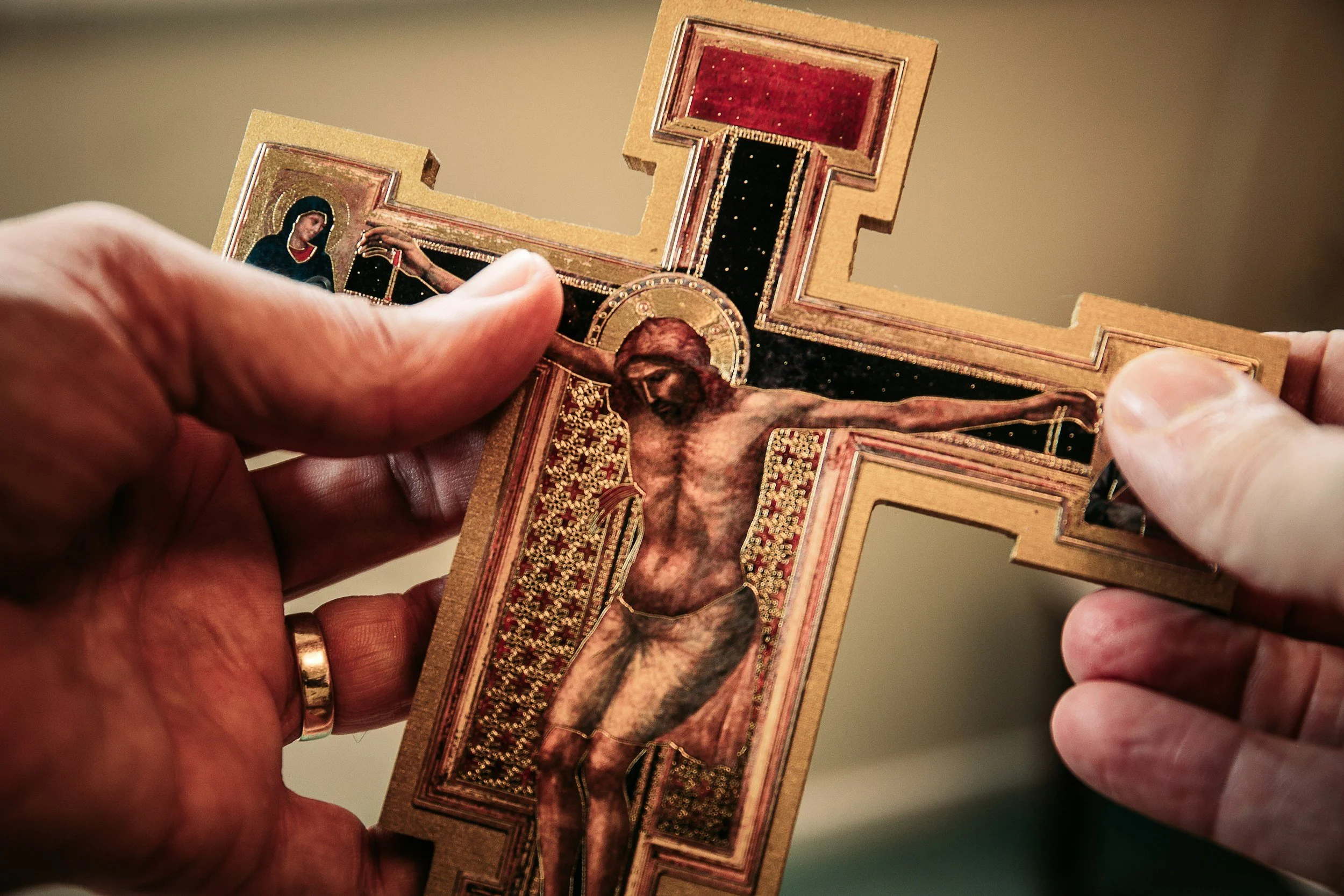
Holy Week is upon us! The Byzantine Catholic Church, of which I am a member, calls Great and Holy Week the “Week of the Bridegroom”. While it is not my intention to turn the Apostolate for Marital Intimacy into a primarily Eastern Catholic apostolate, I do wish to share parts of our practice and tradition when I find it could be edifying for the readers. In addition, I find that my Byzantine Catholicism and my promotion of marriage and marital relations are related. This recent realization was inspired by a quote from the most recent document on marriage released by the Vatican’s Dicastery for the Doctrine of the Faith and signed by Pope Leo XIV called, Una Caro, which means One Flesh, and it focuses on monogamy but reiterates and develops the teaching of the Catholic Church on marriage. I like this document very much and deserves many more articles from us, but sections 39-41, which I wish to share with you in this article, state:
39. In any case, one should recall that the Latin Church places special emphasis on the juridical aspects of marriage, which has led to the beautiful conviction that the spouses themselves are the ministers of the Sacrament.[30] By their consent, they establish a unique and exclusive matrimonial union: an objective fact that precedes any experience or feeling, even a spiritual one. Meanwhile, the Eastern Fathers and the Eastern Churches place greater emphasis on the theological, mystical, and ecclesial aspects of a union that, thanks to the Church’s blessing, is enriched over time under the impulse of grace, while the communion between the spouses becomes increasingly integrated into the communion of the Church. This is why, in the East, the rite of marriage—together with all its signs, and with the prayer and the gestures of the priest—has been given greater prominence. Saint John Chrysostom already speaks of the crowning of the bride and groom (stephánōma) by the priest, and he explains its mystagogical meaning: “For this reason, crowns are placed upon their heads as a symbol of victory, since, having remained undefeated, they reach the marriage bed.”[31]
40. At the same time, a more positive view of the relational dimension of marriage also prevails in the East, which is also expressed in the sexual union in marriage, without reducing its purpose to procreation alone. This is shown, for example, when Saint Clement of Alexandria firmly distances himself from those who consider marriage a sin, even when they tolerate it to ensure the continuation of the species. Instead, he affirms: “If marriage contracted according to the Law is a sin, then I do not understand how anyone can claim to know God while asserting that what God has commanded is a sin. However, if ‘the Law is holy,’ then marriage is holy.”[32] Likewise, Saint John Chrysostom teaches that “marriage must not be regarded as a trade but as a communion of life,”[33] and he emphasizes that excessive continence within marriage could jeopardize marital unity.
41. Matrimonial unity and communion as a reflection of the union between Christ and the Church (cf. Eph. 5:28-30) is a theme particularly developed by the Eastern Fathers, and Saint Gregory Nazianzen draws specific spiritual conclusions from this: “It is well for the wife to reverence Christ through her husband; and it is well for the husband not to dishonor the Church through his wife. […] [But also, may] the husband cherish his wife, for so Christ does the Church.
Before I saw these lines in Una Caro, I was already feeling drawn to want to defend the positive aspects of marriage and the marital act. When I saw this, it was a great gift to realize that this desire I have is deeply connected to the Eastern Church that I am a part of.
Holy Week is the “Week of the Bridegroom” in the Byzantine Church and during Matins from Monday until Thursday of this week we pray, "Behold, the Bridegroom comes in the middle of the night. Blessed is the servant He shall find awake. But the one He shall find neglectful will not be worthy of Him...", and this inspired by the parable of the ten virgins at the beginning of chapter 25 of St. Matthew’s gospel. The theme of the bridegroom carries two deep meanings. “First, it serves as a reminder to be vigilant and prepared for Christ’s return, as we do not know the day or the hour. Second, it signifies Christ’s journey toward becoming the Bridegroom who will unite with His Bride—humanity, fully realized in the Church—through the mystical marriage on the Cross.”
The icon of Christ the Bridgegroom at the top of the article contains nuptial symbolism. The Byzantine Rite of Matrimony is called the “Mystery of Crowning” because the spouses actually receive crowns during the ceremony, and the crowns have a mutli-symbolic meaning. One of those meanings is “the victory of Christ over sin, death, and evil”. Another one of the meanings is that the “crowns also symbolize the crown of martyrdom or witnessing to Christ for the couple incarnates the love of Christ for the Church.” Both of these realities are celebrated during Great and Holy Week as well as during Easter.
While more can be said about why it is fitting for the Byzantine Church to call this week the “Week of the Bridegroom”, I offer this information to our readers so that during this Holy Week, all of our readers, and all Catholics of both the West and the East, may be inspired by and grateful for the love of Christ for the Church, his bride, and for you, reader, individually. May those of you who are married, and those who hope to be in the future, be renewed in your call to make your marriage an icon of the love between Jesus Christ and the Church, and also renewed in the fact that your marriage, and all marriages, really do participate in and make present the love between Jesus Christ and the Church. Also, emphasizing Christ as Bridegroom in this week of His passion reminds us of the link between love, sacrifice, and suffering, which, as followers of Christ our Bridegroom, we are to benefit from but also to practice in our own lives. At this Apostolate, we emphasize with the Church the goodness of marriage and the intimacy that belongs to it, but we also understand the suffering and difficulty that comes with love and marriage, which we exist to help alleviate as much as we can. We also know we cannot alleviate it entirely, but by being rooted in the Catholic faith, we know we cannot alleviate suffering entirely because God never promised to get rid of it. However, through his Incarnation, death, and resurrection, he has redeemed it, and all of us. May you live your marriage (or whichever vocation you have, dear reader) in the great context of our Catholic faith and be renewed in it this Holy Week, so that we may joyfully exclaim at Easter “Christ has emerged from the tomb like a Bridegroom from the bridal chamber, filling the women with joy!”.
Want More Content Like This?
Sign up to get The Catholic Marital Intimacy Blueprint. Plus, if you sign up for SMS, you'll get our Yes, No, Maybe sexual exploration guide for Catholics for FREE! We respect your privacy and will never sell your information.
Get the Blueprint