A Husband’s Crash Course in Natural Family Planning (NFP)
Overview
Natural Family Planning can feel overwhelming for many husbands, especially if it only briefly came up during marriage prep. This crash course breaks down the basics, helping you understand your wife’s cycle, the main NFP methods, and what it actually means for your marriage. It also addresses the real challenges couples face, especially when timing and desire do not align. Most importantly, it invites you to step in, communicate, and lead well in this area of your relationship. If you want to go deeper, there are resources and support available to help you both navigate NFP with confidence.
My guy, if Natural Family Planning feels like a foreign language, you’re not alone.
Maybe you heard about it during marriage prep. Maybe you nodded along, thinking, we’ll figure that out later. And now later is here, and it feels like a confusing mix of charts, apps, and “don’t have sex… sometimes?”
You’re not crazy for feeling lost. So here’s the simple version.
What NFP Actually Is
NFP is not just “Catholic birth control.”
At its core, it’s learning to understand your wife’s fertility cycle. There are certain days when she can get pregnant, and certain days when she cannot. NFP helps you identify those times.
Couples use it for three main reasons:
To avoid pregnancy for a time
To achieve pregnancy
To monitor reproductive health
Different methods use different tools, but they all aim at the same thing: identifying the fertile window.
Why This Matters for You
Your wife is likely the one doing most of the tracking. She’s paying attention to symptoms, logging data, and trying to make sense of it all.
If you stay disengaged, two things usually happen:
She carries the burden alone
Communication around intimacy starts to break down
You don’t need to become an expert overnight. But being involved, even at a basic level, is part of loving her well.
Start simple: know where she is in her cycle.
The Four Main Methods (In Plain English)
There are several approaches to NFP, but here are the four you’re most likely to encounter:
Creighton Method
This is a highly structured system that tracks cervical mucus patterns using a standardized chart.
It’s very precise and is often paired with NaProTechnology doctors, who use the charting to diagnose and treat underlying health issues. If your wife has cycle irregularities or medical concerns, this method is often recommended.
Billings Method
Billings also focuses on cervical mucus, but in a more observational and less structured way.
Instead of strict charting codes, it emphasizes recognizing patterns and sensations over time. It’s simpler to learn, but still requires consistency and communication.
Marquette Method
Marquette uses a hormone monitor (like Clearblue) to measure estrogen and LH levels.
This gives more objective, data-driven results, often with clearer “fertile” and “non-fertile” readings. Many couples prefer this because it reduces guesswork, especially:
Postpartum
During breastfeeding
With irregular cycles
FEMM (Fertility Education & Medical Management)
FEMM combines cycle tracking with a health-focused approach.
It looks at mucus patterns, cycle timing, and hormonal health, and connects couples with medical professionals when needed. It’s especially helpful if you’re thinking long-term about reproductive health, not just timing pregnancies.
What You Actually Need to Know About the Cycle
Let’s give you some basic vocabulary so when your wife talks about her cycle, you’re not completely lost.
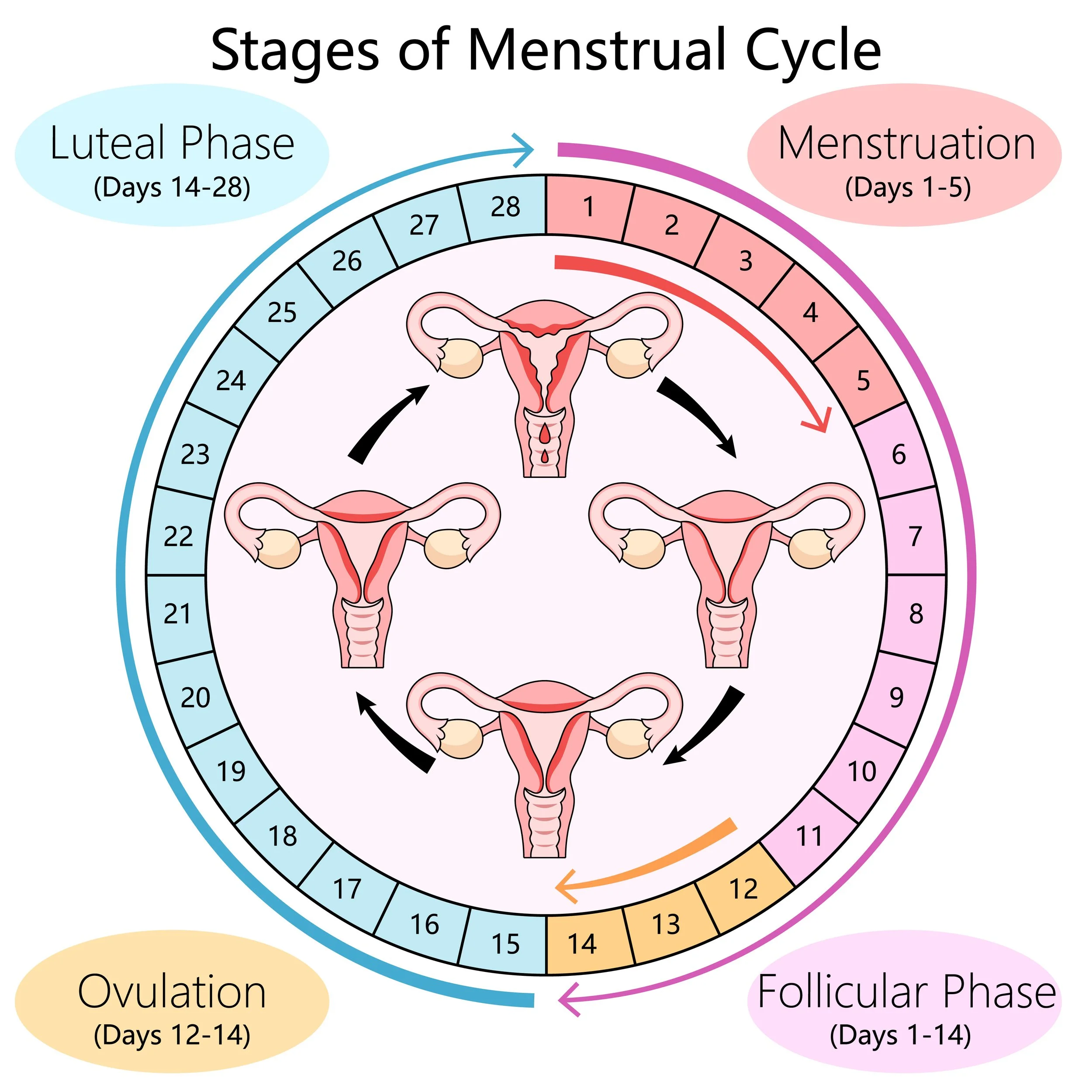
A woman’s cycle has four main phases:
1. Menstruation (Her Period)
This is Day 1 of the cycle
It starts with the first day of bleeding
Hormones are low
Energy and desire are often lower (though not always)
Think: reset phase
2. Follicular Phase
This starts right after her period and leads up to ovulation
Her body is preparing to release an egg
Estrogen is rising
What this often looks like:
Increasing energy
Improving mood
Gradually increasing interest in intimacy
Think: building phase
3. Ovulation (The Fertile Window)
This is when an egg is released
It only lives about 12–24 hours, but sperm can live up to 5 days
That’s why the fertile window is about 5–6 days total
What this often looks like:
Peak attraction and desire
She may feel more confident, affectionate, and interested in sex
If you are trying to avoid pregnancy:
This is when you need to abstain
If you are trying to conceive:
This is go time
Think: high fertility, high desire
4. Luteal Phase
This is after ovulation until her next period
Progesterone rises
What this often looks like:
Desire may decrease
She may feel more tired or withdrawn
PMS symptoms can show up toward the end
This is typically the “safe” time for couples avoiding pregnancy, depending on the method being used.
Think: cool-down phase
Putting It Together
Here’s the simple version:
Fertile window (around ovulation) → possible pregnancy → may need to abstain
Luteal phase (after ovulation) → typically infertile → more freedom for intimacy
And here’s the part to remember:
The time when she is most interested in sex biologically is often the same time you may need to avoid it.
That tension is real. But understanding the cycle helps you navigate it instead of being blindsided by it.
The Part No One Really Warns You About
Here’s where things get hard.
Your wife’s desire often increases during the fertile window. Biologically, her body is primed for connection.
And if you’re trying to avoid pregnancy… that’s exactly when you may need to abstain.
So you get this dynamic:
When she wants you most → you may have to say no
When you’re “in the clear” → she may not be in the mood
That can create:
Frustration
Mixed signals
Feelings of rejection on both sides
This is one of the real challenges of NFP. It’s not talked about enough, and if you don’t expect it, it can quietly wear down your intimacy.
Real Life: It’s Not Always Predictable
Cycles are not always clean and predictable.
Especially:
Postpartum
During breastfeeding
When first learning a method
There can be a lot of uncertainty. You might be asking:
“Are we safe yet?”
“When do we get a clear answer?”
For some couples, it takes time. I’ve worked with couples who were so unsure how to avoid pregnancy that they ended up abstaining for long stretches simply because they didn’t understand the system yet.
Sometimes it takes a couple of months of consistent tracking to really learn her cycle and gain confidence.
That’s normal. It’s frustrating, but it’s part of the learning curve.
How to Not Let NFP Kill Your Intimacy
If you’re trying to avoid pregnancy, abstinence during fertile days is part of the deal. That requires discipline from both of you.
But what you do outside of that matters just as much.
Stay involved. Look at the app or chart together
Talk about expectations ahead of time
Keep pursuing her even when sex is off the table
When you are in a non-fertile time, be intentional
And this is key for husbands:
When it is a time you can be together, don’t just assume it will happen naturally. Be ready to woo her, pursue her, and help her shift into that space, especially if the timing isn’t lining up with her natural desire.
Start Simple
You don’t need to master NFP overnight.
But you do need to stop being a bystander.
Tonight, ask your wife a simple question:
“Where are we in your cycle?”
That one conversation is a better start than most husbands ever make.
If you want to go deeper, we’ve got courses, coaching, and trusted professionals we can connect you with. You don’t have to figure this out alone.
But this is part of your marriage. Step into it.
Want More Content Like This?
Sign up to get The Catholic Marital Intimacy Blueprint. Plus, if you sign up for SMS, you'll get our Yes, No, Maybe sexual exploration guide for Catholics for FREE! We respect your privacy and will never sell your information.
Get the Blueprint