The Permissibility of Sexual Stimulation Outside the Conjugal Act Between Spouses: A Response to Ronald Conte
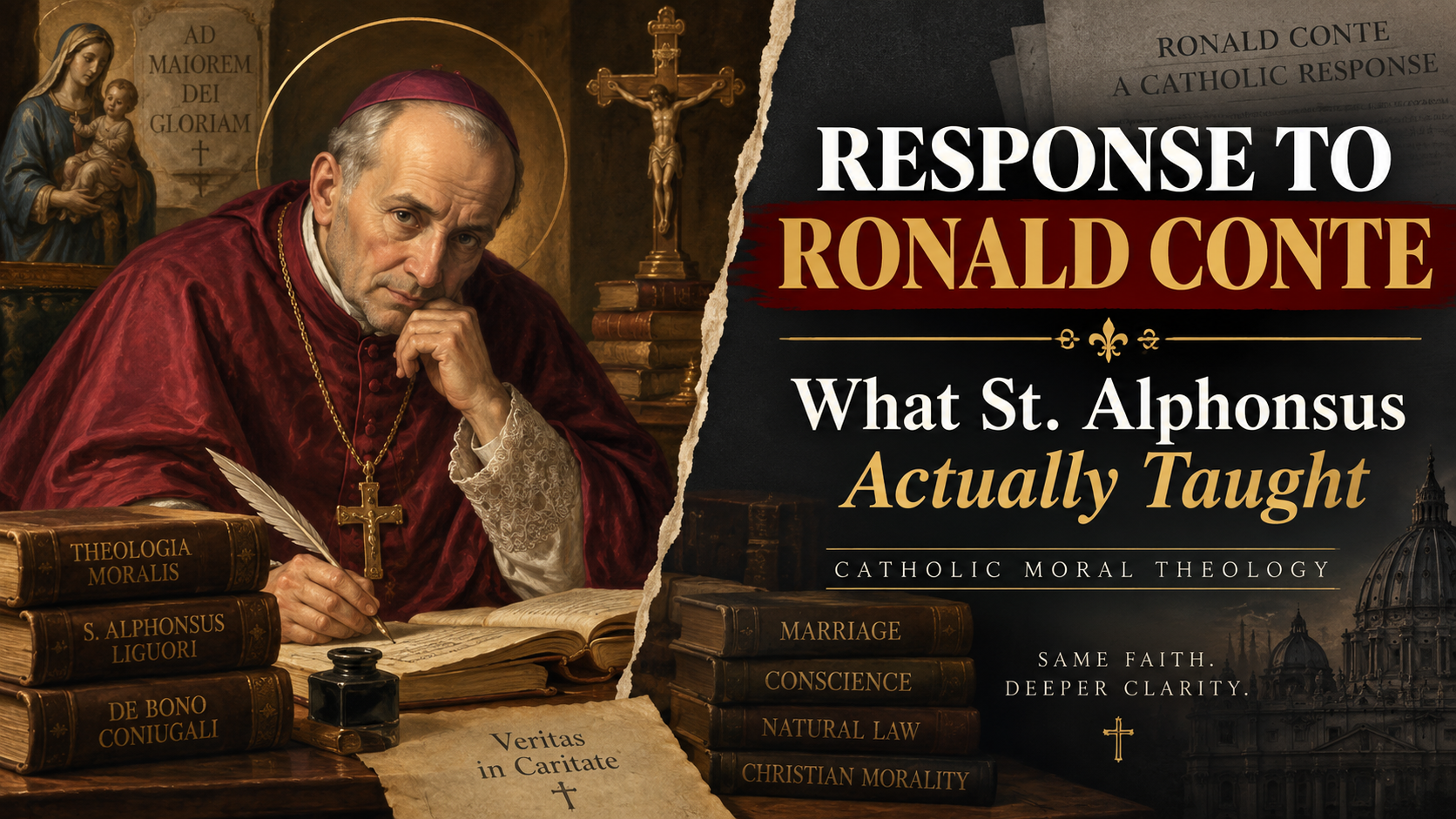
In response to Catholic blogger Ronald Conte’s claim that all sexual stimulation outside penetrative intercourse is gravely sinful, this article examines the teaching of St. Alphonsus Liguori and the broader Catholic moral tradition. It explains why incomplete sexual acts and marital foreplay between spouses have historically been treated far less restrictively than Conte suggests.
One of the most common sources of scrupulosity that drives people to our site comes from a Catholic blogger by the name of Ronald Conte, Jr. While it is not our intention to engage in polemics with Mr. Conte, we do feel it is our responsibility to address some of the claims he makes that drive people to our site in the first place, so as to educate consciences properly and soberly according to the mind of the Church and the minds of Her moral theologians. Most famously, Mr. Conte is known for promoting moral stances on marital sexuality that are far more rigorous and restrictive than those promoted by, for example, popularizers of Theology of the Body such as Christopher West or Gregory Popcak. Perhaps the most commonly cited opinion of Mr. Conte is that all forms of sexual stimulation outside penetrative sexual intercourse are mortally sinful, regardless of whether or not such sexual stimulation brings about an unjustifiable risk of orgasm outside the natural conjugal act. What we want to prove in this article is that Mr. Conte’s perspectives not only do not align with how most moralists think about the question today, but are also out of line with the vast majority of moralists stretching back at least 400 years into Church history, as well as with St. Alphonsus Liguori. Here is Mr. Conte’s position:
“Unnatural sexual acts are intrinsically evil due to the deprivation of the procreative and unitive meanings. And the presence or absence of sexual climax does not change the moral object. An unnatural sexual act with sexual climax has the same evil moral object as an unnatural sexual act without sexual climax.”
Now, this moral reasoning is, without a doubt, not only contrary to the mind of the broad consensus of moral theologians (classical, modern, and contemporary), but actually runs counter to the mind of St. Alphonsus himself. For, in dealing with the question of whether spouses can engage in incomplete acts, even without an intention to consummate the marriage act, St. Alphonsus not only affirms that spouses are able to do this, but also provides clarity as to the nature of what an “incomplete act” would involve. The only way for Conte’s perspective to be consistent with Alphonsus is if they were in agreement about what Alphonsus meant by incomplete acts. For Conte, acceptable foreplay would involve “making out,” hugging, or embracing, as he calls it, and at first glance, Alphonsus’ wording might be construed to mean those things as well. However, if one reads further into Alphonsus’ commentary on this question, it quickly becomes apparent that Alphonsus also has in mind acts that stimulate the genital organs in some way, i.e., sexual stimulation. Let’s first of all pay close attention to the question Alphonsus is addressing, taken from his Theologiae Moralis:
“Ad sint mortales tactus et aspectus turpes inter coniuges propter solam voluptatem, sine ordine ad copulam, si non adsit periculum pollutionis?
English: Are carnal touches and looks between spouses for the sake of pleasure alone mortally sinful when there is no intention to have sexual intercourse, outside danger of orgasm?”
This helps us set the stage for understanding Alphonsus’ position on incomplete sexual acts. When moralists single out sexually stimulating touches, they almost always have recourse to the Latin word turpes, which means shameful. Now, of course, in light of John Paul II’s Theology of the Body, we would not opt for such a term in modern Catholic discourse on sexuality, yet that point of contention lies outside the scope of this article. It remains the case that when moralists do use the term turpes to refer to touches and looks, they have in mind touches and looks that stimulate sexual pleasure in particular. This point is made even clearer when Alphonsus actually summarizes Ron Conte’s position in order to disagree with it, saying, “Anton Sylvius Margar, etc., according to Sanchez, affirm [that such touches and looks are mortally sinful], because, as they say, every actus venereus (venereal act), not related to conjugal intercourse, is mortally sinful.” (Liguori, Theologiae Moralis, Lib. vi. Tract vi, de Matrimonio, 933, q. 4)
Now, in response, St. Alphonsus offers his opinion that such incomplete carnal acts between spouses are not gravely sinful, for “just as the marital state allows for the conjugal act, so likewise it allows for such touches” (Liguori, Theo. Mor., 933, q. 4). While Conte allows for making out between couples, he categorically rejects the moral permissibility of any sexually stimulating acts between them outside of penetrative intercourse. Astonishingly, Mr. Conte winds up arriving at the precise inverse of what the moral tradition teaches is permissible and impermissible. For in another place on his blog, he teaches that because “making out” is not a sexual act, this can be permitted for non-married persons; whereas for married persons (contrary to the decree of Pope Alexander VII), sexual foreplay is forbidden. This is wrong-headed. It is clear from the passage quoted above that the kinds of permissible touches Alphonsus has in mind are those that fall within actus venereus, or venereal acts. But what constitutes venereal pleasure, unlike sensuous pleasure (sense pleasure that does not directly stimulate or derive from the genital organs) or even venereo-sensuous pleasure (pleasure which does not directly stimulate the genitals but derives from them), is specifically pleasure which directly stimulates the genital organs.
Pleasures which stimulate the genitals constitute venereal pleasures, and the acts that accompany this stimulation of the genitals are referred to as venereal acts. Therefore, it is clear that the kinds of touches Alphonsus has in mind are those which stimulate the genital organs in such a way that excludes the proximate danger of pollution, or climax. Such acts are morally legitimate precisely because they do not impede the procreativity of marital sexuality. The malice of sexual sins against nature consists precisely in the frustration of an otherwise fertile consummation of sexual acts which, by nature, belong to natural conjugal intercourse. Such frustration, the moralists say, consists not in the absence of sexual consummation but in the ordering of sexual consummation against its procreative end, i.e., pollution or orgasm outside natural conjugal intercourse. This principle is upheld not only by St. Alphonsus (qq. 916, 933), resting on St. Thomas (Suppl. 49.6), but also by Sanchez, Sporer, the Salmanticenses, Vasquez, Croix, Billuart, Laymann, Palaus, Lessius, Bonacina, Sporer, Sanchez, with Abulensis, Victoria, Diana, Medina, Ledesma; the Salmanticenses, with Vasquez, Fagnanus, Hurtado; La Croix, with Soto, Toletus, Cajetan, Coninck; Tanqueray, Jone-Adelman, Cappello, Merkelbach, Ford-Kelly, Grisez, Noldin, Bucceroni, Lanza, Slater, Ballerini, and others. Check out our Compendium for help tracking down some of these citations. Moreover, per Alphonsus and contrary to Mr. Conte, it would not even constitute a sin against nature for the woman to manually touch herself sexually after penetrative intercourse in order to bring herself to climax as a completion of the act (Liguori, Theologia Moralis, Liber VI, par. 919).
This consensus runs directly counter to Ronald Conte’s position, which classifies such acts as unnatural (regardless of pollution) simply on the basis that they are sexual acts outside the narrow window of consummated penetrative intercourse. The problem, of course, is that he never provides an actual theological argument for this conflation. He simply asserts that the danger of climax is irrelevant and then gathers together all the magisterial, patristic, and theological sources which condemn sexual sins against nature in general and applies those condemnations to incomplete sexual acts, without providing actual proof for his conflation. He writes:
“Each and every sexual act must be marital, unitive, and procreative (open to life) in order to be moral. Ordinary foreplay is not a sexual act, so it does not need to be procreative. But no sexual act becomes moral merely by being labeled as foreplay or by being used for the purpose of foreplay. Unnatural sexual acts are intrinsically evil, and therefore always gravely immoral, because they are not procreative (and not truly unitive).”
This strikes us as a sleight of hand. For it simply begs the question to apply those condemnations to the question at hand when you have failed to adequately prove that such acts fall under those condemnations in the first place. The only argument he offers is his own reasoning, which suggests that it is the sexuality of an act that morally necessitates that it be directly procreative in all of its expressions. However, this runs counter to every magisterial condemnation of unnatural sexual acts. Let’s just analyze a couple. Pope Pius XI’s Casti connubii could not be clearer: “any use whatsoever of matrimony exercised in such a way that the act is deliberately frustrated in its natural power to generate life.” Notice that Pius XI spells out the malice of this unnatural act as consisting specifically in the frustration of a sexual act’s natural power to generate life. Thus, only when a spouse deprives an otherwise fertile sexual act of its power to generate life is such a spouse guilty of an unnatural sex act, which can only apply directly to consummated sexual acts. If this were not clear enough, Pius XII, when he condemns artificial insemination, actually utilizes the distinction between consummated and unconsummated sexual acts, showing that this distinction, contrary to Mr. Conte’s claims, is very morally relevant to what constitutes an unnatural sexual act:
“By the force of this law of nature, the human person does not possess the right and power to the full exercise of the sexual faculty, directly intended, except when he performs the conjugal act according to the norms defined and imposed by nature itself. Outside of this natural act, it is not even given within the matrimonial right itself to enjoy this sexual faculty fully. These are the limits to the particular right of which we are speaking, and they circumscribe its use according to nature...”
Now, any moral theologian worth his salt immediately recognizes the proper way to interpret full exercise in Pius XII’s wording, for it shows up in virtually every single manual of moral theology that touches on sexual matters, however briefly. This full exercise refers specifically to consummated sexual acts that terminate in orgasm. If Pius XII wanted to affirm Mr. Conte’s position, he simply would not have used such a qualifier. He would simply have condemned the deliberate enjoyment of any sexual pleasure whatsoever. He did not do this, which should be reason enough to disregard Mr. Conte’s position as needlessly rigid.
In conclusion, we have proven in this article that the positions Mr. Conte takes with regard to the permissibility of sexual stimulation between married couples outside penetrative intercourse not only run counter to the clear consensus of moralists, but also run counter to the mind of St. Alphonsus and implicitly run counter to the mind of the Magisterium, which has notably refused to condemn precisely the kind of acts Mr. Conte has in mind despite numerous opportunities to do so. We urge Mr. Conte and those who sympathize with his viewpoints to rein in the tendency to impose restrictions on the faithful that have manifestly not been imposed on them by the Church Herself. As the great moralist Archbishop Antonio Lanza put it, “he who permits nothing, can provoke one to all kinds of sin.” Such is often the demonic consequence of the scourge of scrupulosity.
Want More Content Like This?
Sign up to get The Catholic Marital Intimacy Blueprint. Plus, if you sign up for SMS, you'll get our Yes, No, Maybe sexual exploration guide for Catholics for FREE! We respect your privacy and will never sell your information.
Get the Blueprint