Overview
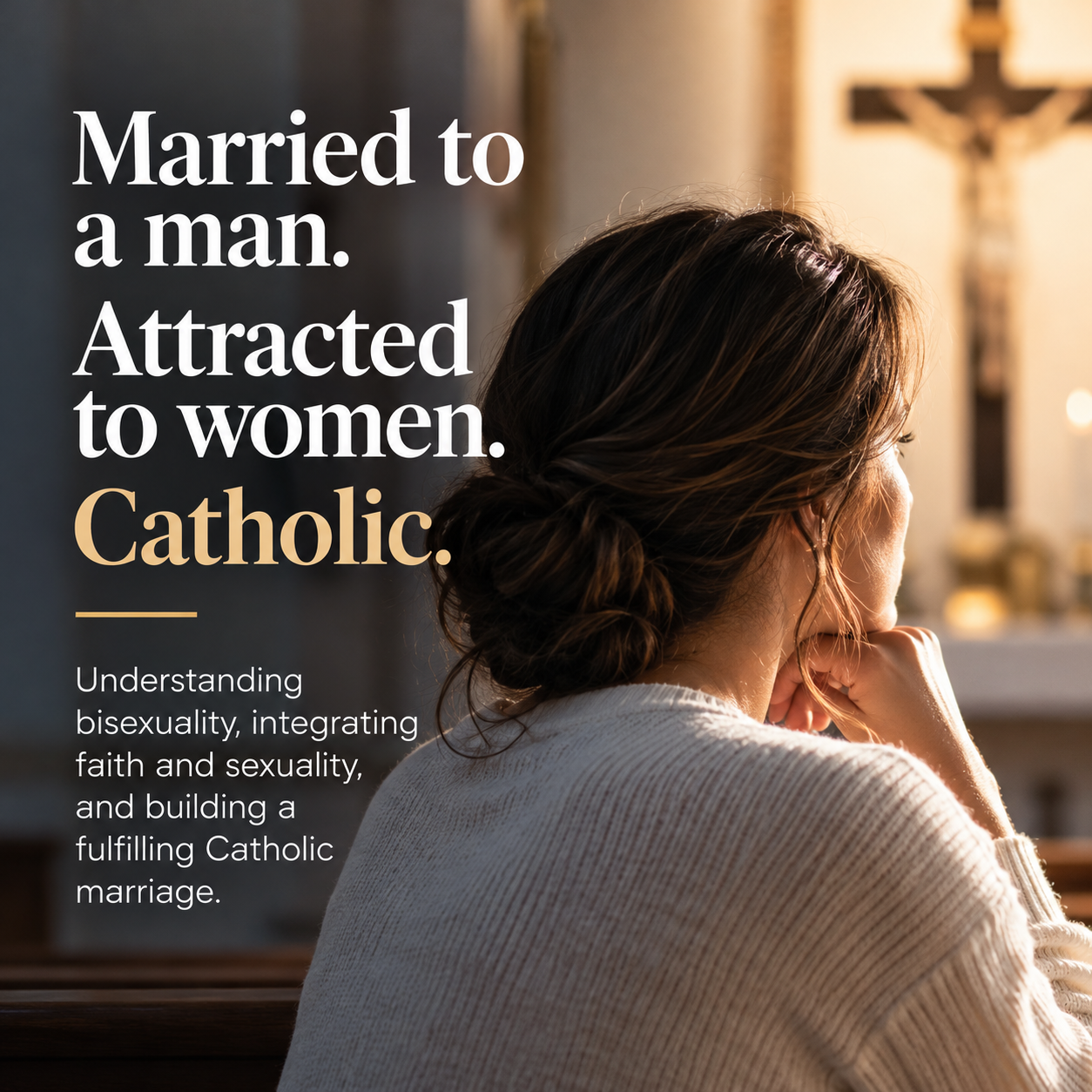
Married to a man, attracted to women, and committed to the Catholic faith? For some wives, navigating bisexual attraction within marriage raises difficult questions about identity, chastity, and intimacy. Explore how Catholic teaching, honest communication, and mutual understanding can help couples integrate sexuality and faith while cultivating a loving, faithful, and sexually fulfilling marriage.
Understanding bisexual attraction and cultivating intimacy within a faithful Catholic marriage
You love your husband. You are committed to your marriage. You take your Catholic faith seriously.
And you are attracted to women.
Perhaps you have known this about yourself since adolescence. Maybe you had a girlfriend before meeting your husband. Perhaps you have been sexually intimate with women in the past. Or maybe you have never acted on these attractions, but they have remained part of your experience for years.
You may genuinely desire your husband and enjoy a satisfying sexual relationship with him. Yet your attraction to women remains.
What does that mean for you as a Catholic wife? And what does it mean for your marriage?
These are questions that deserve thoughtful, compassionate attention. Unfortunately, they are not questions we often hear discussed in Catholic marriage ministries.
We frequently hear about chastity, marital fidelity, and the Church's teachings on homosexuality. Far less often do we acknowledge the experiences of married Catholic women who are attracted to both men and women.
For these women, the challenge is not necessarily choosing between their husband and another relationship. Often, it is understanding how their sexuality fits within a marriage and faith they genuinely cherish.
The good news is that acknowledging one's sexuality, remaining faithful to one's marriage, and pursuing holiness are not mutually exclusive endeavors.
A Reality We Rarely Discuss
Bisexuality is commonly understood as the capacity to experience romantic or sexual attraction to more than one sex or gender. It does not require equal attraction to men and women, nor does it require sexual experience with both.
A woman's sexual orientation is not determined solely by the person she marries.
A bisexual woman married to a man does not automatically become heterosexual. Likewise, her attraction to women does not mean that her attraction to her husband is somehow less genuine.
This is not an insignificant experience among women generally.
According to Pew Research Center (2024), approximately 5% of American women identified as bisexual in a 2023 survey, including 16% of women younger than 30. More recent research found that 87% of partnered bisexual women surveyed were in relationships with men (Minkin et al., 2025).
These findings do not establish how common bisexuality is among practicing Catholic women. However, they demonstrate that bisexual women in relationships with men are not an unusual phenomenon.
For some Catholic wives, their attraction to women has never been a significant source of distress. For others, it raises questions about identity, past relationships, sexual satisfaction, or the meaning of their religious commitments.
Neither experience should be presumed.
The important question is not simply whether a woman experiences same-sex attraction. It is how she understands those attractions and whether they create concerns that she and her husband would benefit from addressing.
Bisexual Attraction Does Not Invalidate a Marriage
One misunderstanding worth addressing is the assumption that a bisexual woman must be dissatisfied with her husband because she also finds women attractive.
This is not necessarily true.
A wife can love her husband, experience genuine sexual desire for him, and remain committed to their exclusive marital relationship while also experiencing attraction to women.
Indeed, attraction and commitment are different things.
Married people do not cease noticing or experiencing attraction to others simply because they exchange wedding vows. Rather, marriage involves freely choosing fidelity and developing a relationship in which love becomes more than the immediate experience of desire.
For a bisexual woman, this includes recognizing that attraction to women does not obligate her to pursue sexual relationships with women.
But neither should she feel compelled to deny that those attractions exist.
A woman who has previously loved another woman may also carry meaningful memories from that relationship. Those memories may involve affection, grief, regret, gratitude, or other complicated emotions.
Acknowledging those experiences does not automatically threaten her marriage.
The question is how she understands them, processes them, and incorporates them into the life she has chosen with her husband.
What the Church Teaches About Chastity and Sexual Integration
Catholic teaching provides an important foundation for this conversation.
The Catechism of the Catholic Church defines chastity as the integration of sexuality within the person, uniting the physical and spiritual dimensions of human life (Catholic Church, 1997, § 2337).
This is an important distinction.
Chastity is not merely a list of sexual behaviors to avoid. It is a virtue through which human sexuality becomes integrated with reason, love, personal responsibility, and the gift of oneself.
The Catechism further explains that chastity involves learning self-mastery, which allows a person to make free and deliberate choices rather than being governed by immediate impulses (§§ 2338–2340).
This understanding applies to every Catholic, regardless of sexual orientation.
The Church teaches that sexual intimacy belongs within marriage between a man and a woman and that sexual acts between people of the same sex fall outside its moral understanding of sexual union (§ 2357).
At the same time, the Church insists that people who experience same-sex attraction must be treated with respect, compassion, and sensitivity, and that unjust discrimination must be avoided (§ 2358).
These teachings should not be confused with the claim that experiencing an attraction is itself equivalent to choosing a sexual act.
For a married bisexual woman, living chastely does not require pretending that she has never experienced attraction to women.
Instead, it involves understanding her experiences and freely choosing how to live in accordance with her faith and marital commitments.
Sexual integration does not require fulfilling every desire. Nor does it require denying that those desires exist.
The challenge is learning how sexuality can become part of a coherent life of faith, love, and personal responsibility.
When Silence Becomes a Burden
For some women, the greatest difficulty is not the attraction itself.
It is the belief that they cannot talk about it.
A Catholic wife may fear that discussing her attraction to women will lead others to question her faithfulness, her morality, or her commitment to her husband.
She may worry that her husband will feel inadequate or interpret her bisexuality as evidence that he cannot satisfy her.
Perhaps she has previously encountered dismissive responses suggesting that because she married a man, her attraction to women no longer matters.
But marriage does not erase a person's history or every aspect of their sexuality.
When a woman believes that an important part of her experience must remain unacknowledged, she may struggle with isolation, shame, or emotional distance.
This does not mean every attraction must be disclosed or that privacy is inherently unhealthy. Some matters require discernment, appropriate boundaries, and careful consideration of the relationship.
Nevertheless, a marriage should ideally provide an environment in which spouses can discuss difficult subjects without fear of humiliation or rejection.
For some couples, opening this conversation may become an opportunity for deeper emotional intimacy.
The objective is not simply to reveal information. It is to develop greater understanding.
Husbands Have an Important Role
A husband learning about his wife's bisexuality may experience a range of emotions.
He may be surprised, confused, curious, or concerned. He may wonder whether she finds him sexually attractive or whether she regrets choosing marriage with a man.
These questions deserve compassionate attention.
However, it is important for husbands to understand that their wives' attraction to women does not necessarily reflect any inadequacy in themselves.
A husband's masculinity, desirability, or ability to satisfy his wife should not be measured against her attraction to women.
Likewise, a wife should not feel responsible for eliminating every uncomfortable emotion her husband experiences while processing this information.
Both spouses need opportunities to understand their experiences.
A husband can begin by listening without immediately attempting to solve the problem.
He might ask his wife what her attractions mean to her, whether she has struggled to discuss them, or whether there are aspects of her sexuality she wishes he understood better.
He can also share his own concerns honestly and respectfully.
These conversations may require patience, particularly when they involve previous relationships or longstanding fears.
Yet they also provide an opportunity for spouses to practice the kind of vulnerability that deepens marital intimacy.
Understanding your spouse does not require having the same experiences. It requires a willingness to take those experiences seriously.
Cultivating a Fulfilling Sexual Relationship
An especially important aspect of this discussion involves marital sexual satisfaction.
Sometimes, the fact that a bisexual wife can experience arousal and pleasure with her husband is treated as sufficient evidence that there is nothing further to discuss.
But marital sexual intimacy involves more than the ability to engage in intercourse or experience orgasm.
It involves mutual understanding, affection, pleasure, communication, and the ongoing discovery of one's spouse.
For some bisexual women, previous relationships with women may have shaped their understanding of physical affection, sexual pleasure, or emotional connection.
For others, their attraction to women may have little influence on their preferences within marriage.
There is no universal bisexual sexual experience.
Consequently, husbands should not assume that their wives desire particular activities simply because they are bisexual.
Instead, spouses can approach sexual intimacy with curiosity and mutual respect.
A wife might reflect on what helps her feel desired, what kinds of affectionate touch she enjoys, or whether she feels comfortable expressing her sexual preferences.
Her husband can likewise share his own desires, concerns, and experiences.
Together, they can explore ways to strengthen their physical relationship within their shared understanding of Catholic marital sexuality.
The Church describes marital sexual intimacy as an expression of conjugal love and a sign of spiritual communion (Catholic Church, 1997, §§ 2360–2363).
Within this understanding, sexual intimacy should express mutual self-giving rather than pressure, obligation, or one spouse's unilateral satisfaction.
Learning how to communicate about pleasure and desire can help couples move beyond established routines and develop a more attentive sexual relationship.
For a bisexual wife, this process may also provide an opportunity to feel that her sexuality is understood rather than dismissed.
Her husband does not need to replicate a previous relationship or compete with an imagined female partner.
He needs to learn how to love and understand the woman he married.
Living an Integrated Catholic Sexuality
The Catholic understanding of chastity invites us to consider sexuality within the context of the whole person.
For a married bisexual woman, this may involve several dimensions of growth.
Personal understanding: Recognizing the reality of her attractions without allowing shame or fear to define her identity.
Emotional growth: Processing past relationships, unresolved feelings, and the experiences that have shaped her understanding of love and intimacy.
Spiritual growth: Deepening her relationship with God while thoughtfully examining how her sexuality relates to Catholic teaching and her conscience.
Marital growth: Strengthening communication, vulnerability, mutual understanding, and sexual intimacy with her husband.
These dimensions are not isolated.
A woman who feels misunderstood may struggle to communicate her sexual needs. A husband who feels threatened by his wife's attractions may find it difficult to respond with openness. A couple uncertain about the Church's teaching may avoid discussing sexuality altogether.
Addressing these concerns can help spouses develop a more integrated understanding of their relationship.
Importantly, this process should not begin with the assumption that bisexuality is itself a psychological problem requiring treatment.
Nor should it assume that a woman's faith must be abandoned for her to experience emotional well-being.
Rather, meaningful growth involves helping her understand herself, examine her values, and make deliberate decisions about the life she wishes to cultivate.
For Catholic spouses who freely choose to live according to the Church's teachings, this can become part of their shared pursuit of marital holiness.
When Additional Support May Help
Some couples can navigate these conversations through prayer, patient communication, and mutual understanding.
Others may benefit from guidance.
A trusted priest or spiritual director may help couples better understand Catholic moral teaching and its application to their lives.
When concerns involve sexual dissatisfaction, shame, emotional distress, communication difficulties, or unresolved relationship experiences, professional couples therapy may also be valuable.
Therapy can provide a structured environment in which both spouses have opportunities to express themselves, explore difficult questions, and develop greater understanding.
It is important, however, that such therapy respect the dignity and autonomy of both spouses.
Professional treatment should not attempt to change a woman's sexual orientation or treat bisexuality as a disorder. Sexual orientation change efforts lack adequate evidence of effectiveness and are discouraged by major professional psychological organizations (American Psychological Association, 2021).
Likewise, faith-informed therapy should not require a woman to abandon her religious commitments.
The appropriate goal is to help couples work toward their freely chosen relational and personal objectives.
Finding Support for Your Marriage
If you are a Catholic woman experiencing attraction to other women, you do not have to navigate these questions alone. Nor does your husband have to figure out how to understand and support you without guidance.
At Archangel Catholic, James Boyd Walther offers specialized, faith-informed couples therapy for marriages in which the wife experiences bisexual attraction.
This work provides a supportive environment to explore sexuality, strengthen communication, deepen emotional and sexual intimacy, and integrate Catholic faith with marital life.
This is not conversion therapy. The goal is not to change or eliminate same-sex attraction, but to help couples develop greater understanding and pursue a fulfilling marriage consistent with their freely chosen values.
Individual therapy may also be available when couples therapy is not appropriate or a spouse chooses not to participate.
Ready to begin the conversation?
Contact Archangel Catholic and request to work with James Walther when submitting your inquiry.
You can acknowledge your sexuality, cherish your husband, and remain committed to your Catholic faith.
You do not need to have every question answered before beginning that conversation.
References
American Psychological Association. (2021). APA resolution on sexual orientation change efforts. https://www.apa.org/about/policy/resolution-sexual-orientation-change-efforts.pdf
Catholic Church. (1997). Catechism of the Catholic Church (2nd ed.). Libreria Editrice Vaticana. https://www.vatican.va/content/catechism/en.html
Minkin, R., Horowitz, J. M., Lin, L., & Braga, D. (2025, May 29). The experiences of LGBTQ Americans today. Pew Research Center. https://www.pewresearch.org/social-trends/2025/05/29/experiences-with-coming-out-as-gay-lesbian-bisexual-or-transgender/
Pew Research Center. (2024, June 28). For Pride Month, key facts about bisexual Americans. https://www.pewresearch.org/short-reads/2024/06/28/for-pride-month-6-facts-about-bisexual-americans/
