
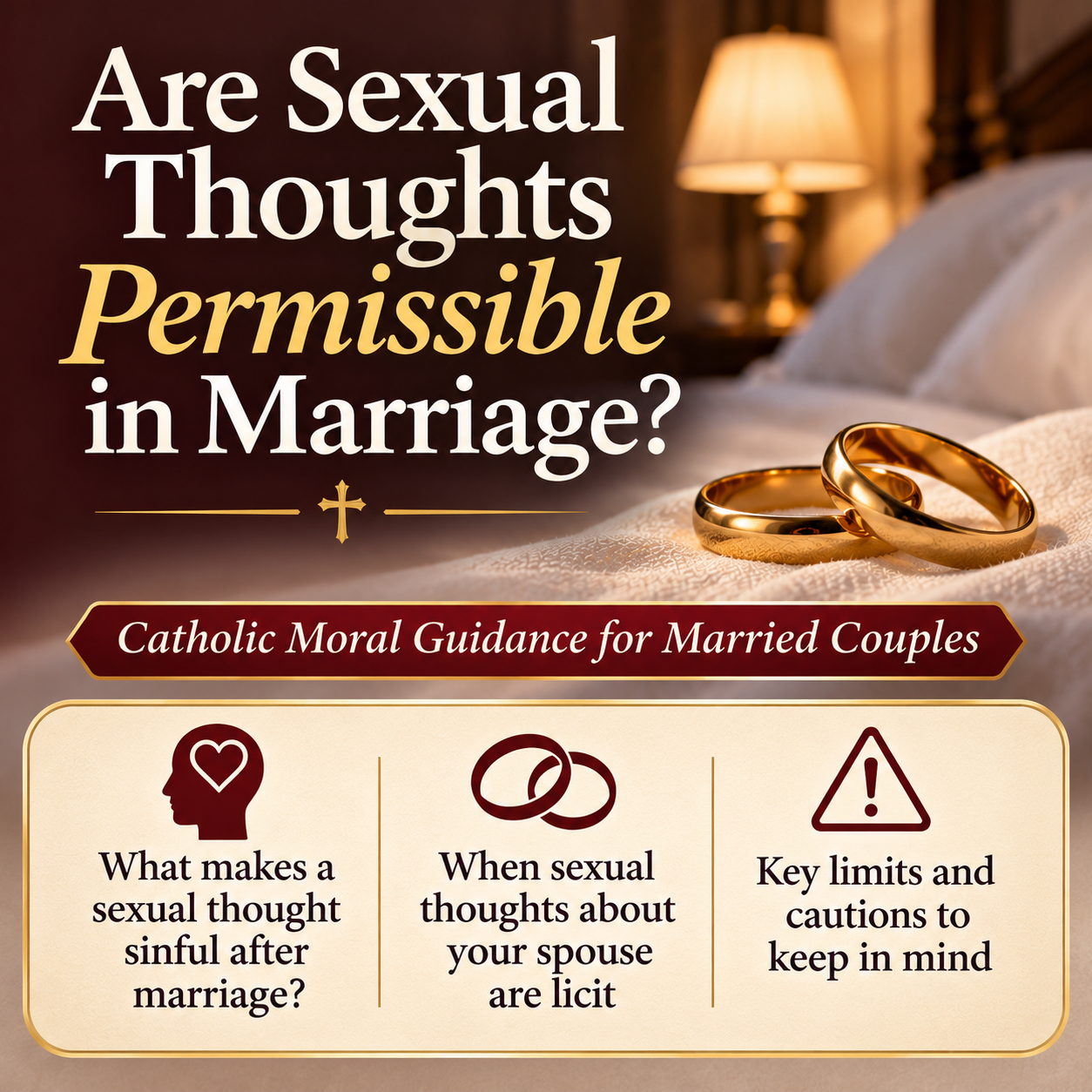
Are sexual thoughts about your spouse sinful in Catholic marriage? Drawing on traditional Catholic moral theology, this article explains when sexual thoughts and fantasies about one’s spouse are morally permissible, when they become sinful, and how married Catholics can distinguish legitimate marital desire from mental adultery or other forms of disordered sexual thought.
For those of us who are married now but who had already taken the Catholic faith seriously before getting married, I’m sure we all remember what it was like to experience various scruples over the moral danger of sexual thoughts and under what conditions they were gravely sinful, venially sinful, or not sinful. Prior to marriage, of course, the standard is quite straightforward: it is always gravely sinful to deliberately consent to the pleasure of a sexual thought prior to marriage.
But what about after marriage? After marriage, the center of moral gravity for for examining one’s conscience shifts away entirely from the sexual nature of the thought and toward the object of the sexual thought. That is, when we are married, the sinfulness of sexual thoughts no longer has merely to do with the fact that they are sexual, but with what it is we are consenting to in the entertainment of those thoughts. Let’s break this down a bit into a few moral maxims that we can comfortably rely on in our moral discernment:
Regardless of what the sexual thought is about, if the thought is not consented to with a full act of the will, then it does not constitute a mortal sin. Mortal sin requires full consent of the will. Therefore, if the sexual thought simply enters the mind without full deliberation of the will and there is no deliberate act of the will to entertain this thought, regardless of content, this does not impute grave guilt upon the soul.
Sexual thoughts about one’s spouse are as a rule morally licit under the following conditions:
The object of the sexual thought is your lawful spouse and no one else.
That is, no one other than your lawful spouse (except perhaps yourself in relationship with your lawful spouse) constitutes the object of any pleasures associated with the thought. You must be able to truthfully recognize the person in your mind as your lawful spouse and no one else. If the visual image of your spouse begins to shift into some other likeness, you are obligated to divert your mind to other things. To willfully entertain sexual thoughts about someone other than your lawful spouse constitutes the grave sin of mental adultery.
That sexual thoughts about one’s lawful spouse are permissible is supported by the moral tradition of the Church. Here is one example, taken from Fr. Felix Cappello, whose view is supported by the greater consensus of authorts: “Thoughts, pleasures and desires - Internal pleasures, concerning those sexual acts which are permissible for spouses, are not sins; insofar as a spouse delights in what is venially sinful, such internal pleasures are venially sinful, insofar as a spouse delights in what is gravely sinful, those pleasures are gravely sinful, because pleasure receives its morality from the object of that pleasure. Carnal pleasure, which arises from a sexual thought about something per se permissible in marriage and which is voluntarily enjoyed outside of intercourse, excluding the danger of masturbation, is not a sin in itself, because the marital state makes such sexual thoughts permissible.” [1]
The sexual thought does not involve something that if done in reality would be prohibited under grave sin. So, sexual fantasies about your spouse that involve intrinsically evil acts, or scenarios wherein you are not actually married to your spouse, would be gravely sinful, because the morality of mental pleasure is always derived from the moral character of its object.
Caveat: While it would be sinful to, for example, take pleasure in a sexual scenario in which you are not married to your spouse, say, while you were dating you spouse, it would not necessarily be sinful to take pleasure in characteristics or traits about your spouse during that time, since your spouse was obviously the same person before marriage. So, say your spouse looked a certain way during a date before you got married and you take a kind of pleasure in that memory that would have been forbidden for you before you got married. This would be licit. But if during that same date you engaged in illicit acts, it would not be permissible to take pleasure in the illicit nature of the acts themselves (that is, if the fact that you were unmarried became part of what was taken pleasure in now, looking back).
The sexual thought does not constitute a proximate danger for the sin of solitary pollution (or, masturbation).
The sexual thought does not involve your spouse doing something fundamentally at odds with his or her tastes or character.
Sexual thoughts about your spouse are not enjoyed purely for the sake of its associated pleasures to the exclusion of all other honorable purposes (such as fostering or preserving conjugal love). This, however, would only be prohibited under venial sin.
So long as these principles are observed, you need not suffer scruples about sexual thoughts. As Fr. John Hardon writes,
“Husband and wife must learn that their chastity is very different from what it was before they married. The whole state of their life is changed. They are neither brother nor sister, neither master nor servant. Before God, they will be held responsible for many things that do not concern the unmarried; their duties are different. For this reason, He has attached numerous privileges to the married state that no one else may legitimately enjoy.” [2]
Footnotes:
Fr. Felix Cappello, SJ, Tractatus canonico moralis de Sacramentis: De matrimonio
Fr. John A. Hardon, SJ, Moral Theology, Chapter VII: "Birth Control"
