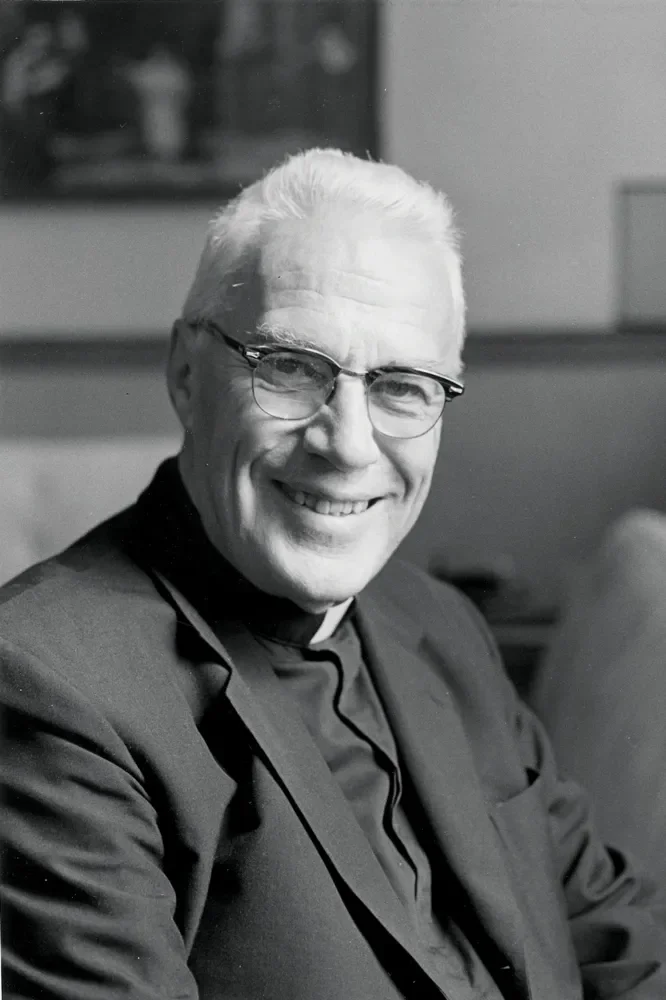
Is it sinful for Catholic spouses to engage in marital intimacy simply for pleasure? In this excerpt, renowned moral theologian Fr. John C. Ford, S.J., examines the traditional Catholic concern with acting ob solam voluptatem (“for pleasure alone”) and explains why, in light of various papal decrees, seeking sexual pleasure within rightly ordered marital intimacy need not be sinful or contrary to the purposes of marriage.
Fr. John C. Ford, S.J., was a leading 20th-century Catholic moral theologian who taught at Weston College, the Pontifical Gregorian University, and The Catholic University of America, and played a leading role in drafting the minority report of Pope St. Paul VI’s Papal Birth Control Commission defending the Church’s traditional teaching on contraception. The following excerpt is taken from Fr. Ford’s Contemporary Moral Theology Volume II: Marriage Questions, which was also co-authored by Fr. Gerald Kelly.
The theologian also recalls, not without some degree of discouragement, the historic difficulties in giving a reasonable interpretation to Innocent's condemned proposition. In the first place, there is the fact that the whole group of sixty-five propositions were condemned in globo, as being "at the very least scandalous and in practice pernicious."
No precise note or theological censure can be attached to any proposition; and none of the propositions need be "erroneous." Moreover, as regards proposition 9 (of which we are speaking) the difficulty of interpretation is enhanced by the diversity of theological views concerning the inherent moral quality of marriage and the marriage act, concerning the possibility of having morally indifferent acts in concreto, concerning the requisite finis operantis (the purposes of those who act) for a morally good act and for supernatural merit, and so forth.
These difficulties are fewer today than formerly; but they have not been sufficiently resolved for anyone to say that there exists in Catholic theology a truly common opinion concerning the general question of acting ob solam voluptatem [for pleasure alone], or concerning the particular application of this matter to the finis operantis of conjugal intimacy.
It would obviously be impossible for us to try to filter through the centuries of debates, real and verbal, on these many questions; and it would be almost equally impossible to offer a coherent presentation of the conflicting views concerning the meaning of Innocent's condemnation of proposition 9. But we are on perfectly safe ground in saying it is theologically and pastorally tenable that spouses do not act ob solam voluptatem when, though their sole explicit and conscious motive in exercising their marital intimacies is pleasure, they actually do nothing contrary to the norm that enjoyment is subordinate to action.
For centuries it has been asserted that God and nature have attached sexual pleasure to the generative act as an inducement to men to propagate. Thus God provides for the good of the species. Granting, for the sake of the argument, that this is so, we would like to make this comment. If sexual pleasure is to serve as an inducement to propagate, then God must want men to choose the act because of the pleas-ure, not the other way round. If they were to choose the pleasure because of the act a process psychologically difficult to envision), the pleasure would not be an inducement at all. The older authors seemed oblivious of this psychological aspect of the matter.
But to choose the act because of the pleasure is by no means to act ob solam voluptatem, or to subordinate the act to the pleasure. When one responds as God intended to an inducement which by a "pleasant conspiracy of nature" serves the purposes of marriage and the good of the species, one is not inverting the order of nature; one is observing it.
To us this remark seems to confirm the position that those who consciously act for the pleasure of sexual intercourse, apprehended as something permissible, need no further explicit legitimating motive to escape the imputation of acting ob solam voluptatem. In other words, if their conduct in marital intimacies is such that it preserves the inherent purposes or values which belong to conjugal intimacy, the pleasure they seek is well-ordered; they cannot be said to be acting ob solam voluptatem.
The conjugal act is primarily procreative; but it is also an expression of love, a safeguard of chastity, a debt of justice.
Moreover, it not only expresses love, but fosters it, and this not merely in the sphere of sense, but also in the spiritual order; and because of this it fosters the union of souls that should prevail throughout every aspect of the conjugal life-partnership. Finally, as pointed out previously, the moderate exercise of conjugal intimacies serves as a relief of tension, and in this way, too, makes for a greater harmony in married life, for greater contentment and peace.
When conjugal intimacies are exercised in such a way that these values, as well as their natural interdependence, are preserved, the spouses cannot be said to be acting ob solam voluptatem, even though their sole explicit and conscious motive is pleasure. In such conduct, therefore, there is no hedonism, in the sense of something clearly sinful. It is possible however, that their exaggerated desire for pleasure may be such as to frustrate the higher values of Christian asceticism; such exaggeration, though falling short of any sin, can be said to be hedonistic.
Hedonism is not a specific sin. Rather it is a vice; and like many vices (e.g., selfishness, laziness, pride) it may be the direct source of sinful acts or it may operate in a subtler way by fostering a self-indulgence which undermines Christian detachment, or jeopardizes the spirit of renunciation and other-worldliness called for by the doctrine of the Cross. We believe that this distinction may offer some light on the remarks made by Pius XII to the midwives and to the French fathers of families. At times the Pope is speaking of a pleasure-loving attitude which is directly productive of sin in the exercise of conjugal intimacies; and at other times he is speaking in broader terms of a mentality which, though not directly involving sinful conduct, is contrary to the Christian spirit that should be the guiding light of those who are married in Christ. Obviously this latter men-tality, though not immediately the source of sin, may eventually endanger the strict obligations of married life and lead even to grossly sinful conduct. In a word hedonism may mean something anti-Christian, that is, conduct which is actually sinful; and it may mean something un-Christian, that is, inordinate as being more or less profoundly at variance with the pursuit of Christian perfection. Some such distinction as this seems to be implicit in Pius XII's remarks on human dignity in conjugal relations, though he himself uses the term "anti-Christian" to embrace both kinds of hedonism.
