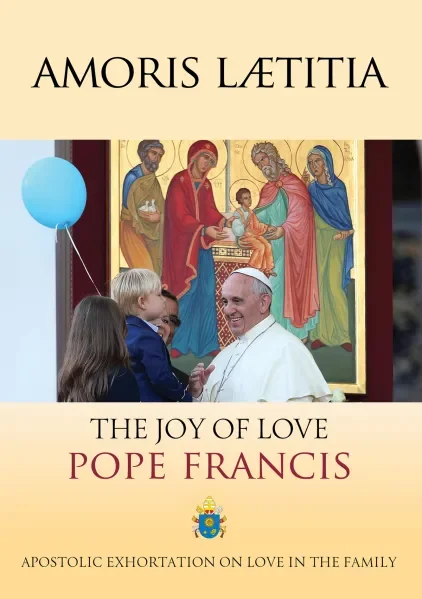
In Amoris Laetitia, Pope Francis shares many beautiful insights about the goodness of sexual pleasure within the marital act, which are combined with appropriate warnings against seeking only pleasure to the exclusion of love and all other honorable ends, and in sharing these insights, contributes to an overall positive view of the Magisterium of sexual pleasure in the marital act and in marriage.
125. Marriage is likewise a friendship marked by passion, but a passion always directed to an ever more stable and intense union. This is because “marriage was not instituted solely for the procreation of children” but also that mutual love “might be properly expressed, that it should grow and mature”. This unique friendship between a man and a woman acquires an all-encompassing character only within the conjugal union. Precisely as all-encompassing, this union is also exclusive, faithful and open to new life. It shares everything in constant mutual respect. The Second Vatican Council echoed this by stating that “such a love, bringing together the human and the divine, leads the partners to a free and mutual self-giving, experienced in tenderness and action, and permeating their entire lives”.
Joy and beauty
126. In marriage, the joy of love needs to be cultivated. When the search for pleasure becomes obsessive, it holds us in thrall and keeps us from experiencing other satisfactions. Joy, on the other hand, increases our pleasure and helps us find fulfillment in any number of things, even at those times of life when physical pleasure has ebbed. Saint Thomas Aquinas said that the word “joy” refers to an expansion of the heart.127 Marital joy can be experienced even amid sorrow; it involves accepting that marriage is an inevitable mixture of enjoyment and struggles, tensions and repose, pain and relief, satisfactions and longings, annoyances and pleasures, but always on the path of friendship, which inspires married couples to care for one another: “they help and serve each other”.128 127. The love of friendship is called “charity” when it perceives and esteems the “great worth” of another person.129 Beauty – that “great worth” which is other than physical or psychological appeal – enables us to appreciate the sacredness of a person, without feeling the need to possess it. In a consumerist society, the sense of beauty is impoverished and so joy fades. Everything is there to be purchased, possessed or consumed, including people. Tenderness, on the other hand, is a sign of a love free of selfish possessiveness. It makes us approach a person with immense respect and a certain dread of causing them harm or taking away their freedom. Loving another person involves the joy of contemplating and appreciating their innate beauty and sacredness, which is greater than my needs. This enables me to seek their good even when they cannot belong to me, or when they are no longer physically appealing but intrusive and annoying. For “the love by which one person is pleasing to another depends on his or her giving something freely”.
Passionate Love
142. The Second Vatican Council teaches that this conjugal love “embraces the good of the whole person; it can enrich the sentiments of the spirit and their physical expression with a unique dignity and ennoble them as the special features and manifestation of the friendship proper to marriage”. For this reason, a love lacking either pleasure or passion is insufficient to symbolize the union of the human heart with God: “All the mystics have affirmed that supernatural love and heavenly love find the symbols which they seek in marital love, rather than in friendship, filial devotion or devotion to a cause. And the reason is to be found precisely in its totality.” Why then should we not pause to speak of feelings and sexuality in marriage?
God loves the joy of his children
147. This calls for a pedagogical process that involves renunciation. This conviction on the part of the Church has often been rejected as opposed to human happiness. Benedict XVI summed up this charge with great clarity: “Doesn’t the Church, with all her commandments and prohibitions, turn to bitterness the most precious thing in life? Doesn’t she blow the whistle just when the joy which is the Creator’s gift offers us a happiness which is itself a certain foretaste of the Divine?” He responded that, although there have been exaggerations and deviant forms of asceticism in Christianity, the Church’s official teaching, in fidelity to the Scriptures, did not reject “eros as such, but rather declared war on a warped and destructive form of it, because this counterfeit divinization of eros… actually strips it of divine dignity and dehumanizes it”.
148. Training in the areas of emotion and instinct is necessary, and at times this requires setting limits. Excess, lack of control, or obsession with a single form of pleasure can end up weakening and tainting that very pleasure144 and damaging family life. A person can certainly channel his passions in a beautiful and healthy way, increasingly pointing them towards altruism and an integrated self-fulfillment that can only enrich interpersonal relationships in the heart of the family. This does not mean renouncing moments of intense enjoyment, but rather integrating them with other moments of generous commitment, patient hope, inevitable weariness, and struggle to achieve an ideal. Family life is all this, and it deserves to be lived to the fullest.
149. Some currents of spirituality teach that desire has to be eliminated as a path to liberation from pain. Yet we believe that God loves the enjoyment felt by human beings: he created us and “richly furnishes us with everything to enjoy” (1 Tim 6:17). Let us be glad when with great love he tells us: “My son, treat yourself well… Do not deprive yourself of a happy day” (Sir 14:11-14). Married couples likewise respond to God’s will when they take up the biblical injunction: “Be joyful in the day of prosperity” (Ec 7:14). What is important is to have the freedom to realize that pleasure can find different expressions at different times of life, in accordance with the needs of mutual love. In this sense, we can appreciate the teachings of some Eastern masters who urge us to expand our consciousness, lest we be imprisoned by one limited experience that can blinker us. This expansion of consciousness is not the denial or destruction of desire so much as its broadening and perfection.
The erotic dimension of love
150. All this brings us to the sexual dimension of marriage. God himself created sexuality, which is a marvelous gift to his creatures. If this gift needs to be cultivated and directed, it is to prevent the “impoverishment of an authentic value”.146 Saint John Paul II rejected the claim that the Church’s teaching is “a negation of the value of human sexuality”, or that the Church simply tolerates sexuality “because it is necessary for procreation”.147 Sexual desire is not something to be looked down upon, and “and there can be no attempt whatsoever to call into question its necessity”.
151. To those who fear that the training of the passions and of sexuality detracts from the spontaneity of sexual love, Saint John Paul II replied that human persons are “called to full and mature spontaneity in their relationships”, a maturity that “is the gradual fruit of a discernment of the impulses of one’s own heart”.This calls for discipline and self-mastery, since every human person “must learn, with perseverance and consistency, the meaning of his or her body”. Sexuality is not a means of gratification or entertainment; it is an interpersonal language wherein the other is taken seriously, in his or her sacred and inviolable dignity. As such, “the human heart comes to participate, so to speak, in another kind of spontaneity”. In this context, the erotic appears as a specifically human manifestation of sexuality. It enables us to discover “the nuptial meaning of the body and the authentic dignity of the gift”. In his catecheses on the theology of the body, Saint John Paul II taught that sexual differentiation not only is “a source of fruitfulness and procreation”, but also possesses “the capacity of expressing love: that love precisely in which the human person becomes a gift”. A healthy sexual desire, albeit closely joined to a pursuit of pleasure, always involves a sense of wonder, and for that very reason can humanize the impulses.
152. In no way, then, can we consider the erotic dimension of love simply as a permissible evil or a burden to be tolerated for the good of the family. Rather, it must be seen as a gift from God that enriches the relationship of the spouses. As a passion sublimated by a love respectful of the dignity of the other, it becomes a “pure, unadulterated affirmation” revealing the marvels of which the human heart is capable. In this way, even momentarily, we can feel that “life has turned out good and happy”.
Also, in case one is tempted to believe that all of the good things the Pope says here about sexual pleasure require that the couple intend to conceive during each marital act for the sexual pleasure to be as good as he says it is, note that early in the document, he says this:
“We need a healthy dose of self-criticism. Then too, we often present marriage in such a way that its unitive meaning, its call to grow in love and its ideal of mutual assistance are overshadowed by an almost exclusive insistence on the duty of procreation.” (Amoris Laetitia, 36)
All of the above leaves no doubt that the Magisterium of the Catholic Church teaches that the passion and pleasure of married love are a gift from God and are to be viewed in a positive light. We hope the readers find these excerpts as enriching and enlightening as we do.