Defer to One Another In Marriage
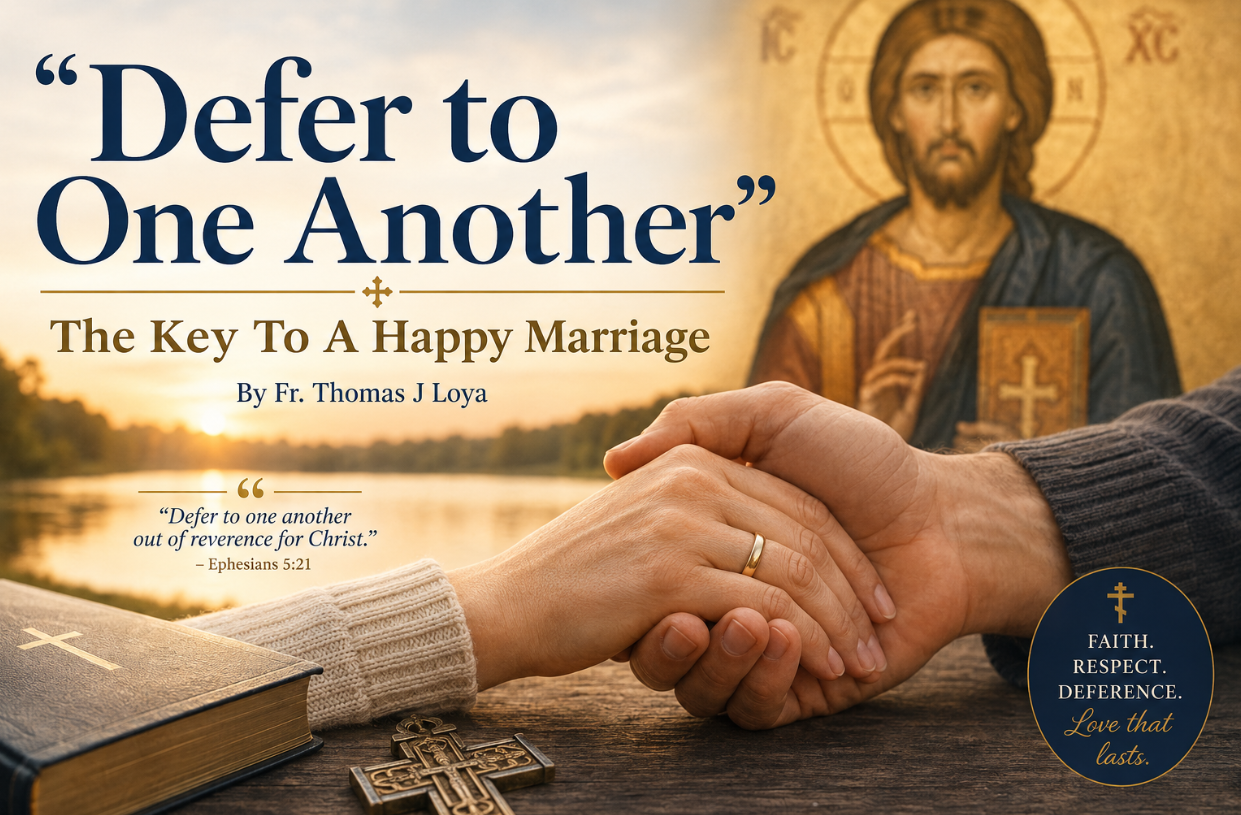
The following article was originally published in the April 2025 edition of Horizons magazine, which is the official magazine of the Byzantine Catholic Eparchy of Parma, where Fr. Loya is the Director of Marriage and Family Life. This article has been republished here with Fr. Loya’s permission. It shares with us a word that he calls the “magic pill” for a happy marriage. That word is “defer”. Please read this article to learn more about what Fr. Loya calls, “deferential love”.
It is an example of the genius of the Byzantine Liturgical tradition that at wedding ceremonies the only Epistle reading that is prescribed for this ceremony is Ephesians 5:21. In that passage there is a singular, 'secret' word, so to speak, for a holy, happy and lasting marriage. The word is "defer"—"defer to one another out of reverence for Christ." Sometimes this word is translated, "be subordinate" to one another out of reverence for Christ. Deferential love, and from that, deferential communication, is a special characteristic of true Christian love, and it is particularly crucial in marriage. Deferential love and deferential communication are the two thing that can prevent and heal problems in a marital relationship. This is because ultimately, proper spirituality is what keeps a marriage holy, healthy, happy and healing when healing is necessary. Marriage and family counseling will never be totally effective if it is not rooted in a spirituality of deference. Even if a couple finds that secular counseling is being effective for them, it is actually because, perhaps unbeknownst to the counselor, there is some form of deferential love and communication being prescribed and practiced in the counseling process. Here are just some of the ways that deferential love and communication work and why deference is essential in keeping marriages holy and happy:
1. Deferential love (and therefore effective marriage counseling) is never about blaming. It is about a search for insight and BOTH parties then making necessary adjustments based on the insights into each other's legitimate needs, hurts, background, behavior, and reactions.
2. When marriages are experiencing strife, there is a very common tendency for the couple to identify the "bad guy" in the marriage and think that "if we can just "fix up" the "bad guy" the marriage will be happy!" This is a myth. There is no such thing as THE "bad guy" in a marriage! There can be bad behavior and bad ways of reacting to one's spouse or situations. But there is no "bad guy." No matter the behavior of one or other of the spouses, the other spouse (who sees himself as the "good guy") must ask himself, “What is it that I can do or not do that can help the situation, help the other person react and behave better?" This is deferential love.
3. Deferential love does not say things like: "YOU made me angry! It's YOUR fault! You ALWAYS...! Your NEVER...! If YOU would just STOP...! If you would just START!” Rather, deferential love and communication have each spouse saying things like this: "Maybe I just did not hear you correctly. Can you explain to me again what you want or what your concern is?" "I feel uneasy when this happens or when you say this. Can we look at that? Maybe it is ME who is not perceiving things correctly, or I might be reacting out of my own hurts or sensitivities." "Perhaps I did not communicate my message to you adequately. Let me try saying it again another way."
4. Deferential love seeks benign explanations first to something that might be confusing or troubling rather than right away assuming malignant intentions, being suspicious and accusing.
5. In deferential love each person asks himself, "Is there any other way that I could possibly interpret what was said or done? Is this the only interpretation I can have of what was said or done (or not said or not done?)”
6. Deferential love is not afraid to apologize often.
7. Deferential love and communication strive to be truly present and receptive to what the other person is communicating, especially if that person is upset or confused. The person listening should not be thinking about his comeback line while the other person is expressing himself. Rather, the listener simply focuses on understanding not so much the other person's words but their message. Repeat back to the person what you believe was the other person's message so that the person who was speaking knows that he has been understood.
8. Deferential love and communication never call the other person derogatory names and NEVER uses the "F" bomb or the Lord's name in vain.
9. Deferential love and communication do not berate or criticize the family of the other spouse, especially his or her parents. It never says things like: "You are just like your mother! (or father)." Or, “Your family is so messed up!"
In summary, no matter how fierce the feelings and strife in a marriage the Christian husband and a Christian wife must NEVER forget that they are first and foremost a brother and sister in the Lord, that they are a Christian man and a Christian woman, and they must be that toward each other regardless of the intensity of the hurt and anger. In these misguided times people have a tendency to believe that if they are angry their anger is the sum total of reality and they are always justified in that anger and therefore justified in expressing that anger however they want even if it dehumanizes the other person and becomes behavior unbecoming of a Christian person. Deferential love “bows” to the other person. It makes the other person more important than ourself. Of course, both spouses must learn to practice this. It is something that was very graphically modelled by Jesus Christ when, to St. John the Baptist's surprise, Jesus Christ deferred to St. John at Christ's baptism in the Jordan River. Jesus even insisted that St. John accept Christ's deference to St. John. In the end they both deferred to each other and humanity was saved. So, it can be as well for our marriages when we can learn the art of "deferring to one another out of reverence for Christ."
Want More Content Like This?
Sign up to get The Catholic Marital Intimacy Blueprint. Plus, if you sign up for SMS, you'll get our Yes, No, Maybe sexual exploration guide for Catholics for FREE! We respect your privacy and will never sell your information.
Get the Blueprint